
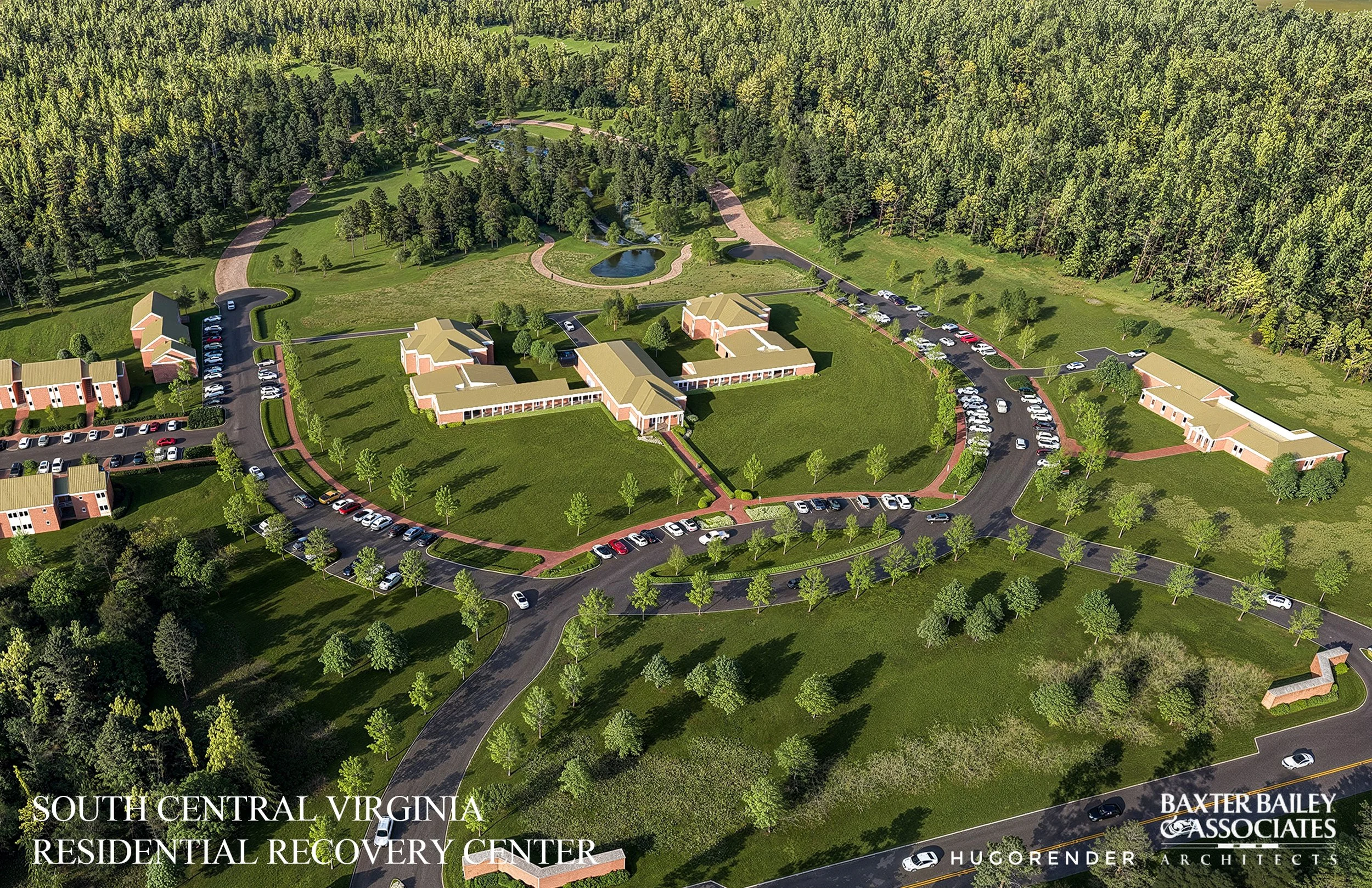
VCDC is excited to welcome the South-Central Virginia Recovery Campus to our portfolio.
With the Joint Commission for Recovery Housing
A safe place to live, support from people who understand, and a chance to find steady work can make a fundamental difference for someone rebuilding their life in recovery. In Southern Virginia, the Joint Commission For Recovery Housing (JCRH) came together after recognizing that this type of holistic, critical support has been missing for some time in the region. The solution: The new South-Central Virginia Recovery Campus (SVCRC).
Located in South Boston, VA, the SVCRC is designed for individuals recovering from substance use disorder in rural Southside Virginia counties of Halifax, Buckingham, Lunenburg, Prince Edward, Brunswick, and Charlotte. Plans for the 53-acre site include a treatment center with 76 transitional beds which Southside Behavioral Health will operate through a comprehensive scope of recovery and rehabilitation services. The next phase will add 32 permanent supportive rental apartments, developed by Southside Outreach Group, giving individuals an opportunity to live more independently while staying connected to recovery support.
The campus will also incorporate a Workforce Training Center to provide residents with employment preparedness and training skills to become more qualified for high-demand jobs. For residents and other community members, the center will help individuals gain valuable skills for locally hiring jobs, connecting new workers to the region while helping people build life-long skills that keep them in stable employment.
JCRH’s work grew out of a statewide effort to address the housing challenges facing justice-involved individuals and participants in the recovery court docket program. After bringing together court representatives, housing leaders, behavioral health professionals, and other community partners, JCRH realized how difficult it can be to sustain recovery when housing and everyday support are out of reach. These challenges are especially pronounced in rural communities of South-Central Virginia, where transportation barriers and limited nearby services leave people with few options. Currently, there is no single certified recovery housing program in Halifax County, despite the growing need for services. In Halifax County alone, the overdose mortality rate, which more than doubled from 2018 to 2023, is almost twice that over the overall state. The need for a local, multi-faceted campus is critical and SVCRC has been carefully designed to directly alleviate this service gap.
Real-life examples of similar recovery housing models show why this type of support matters. The Recovery Kentucky model, which informs JCRH’s approach, gives people a stable place to live while they build recovery skills. A 2024 University of Kentucky evaluation found that alcohol or illicit drug use fell from 94% in the six months before program entry to 14% in the six months before the one-year follow-up. Participants also reported fewer arrests, less time incarcerated, and longer time in employment. These improvements point to the promise of giving people a supportive community and time to rebuild.
As this transformative project moves from conceptualization to predevelopment, VCDC is proud to support JCRH in filling financing gaps to help bring the project to fruition. Our CDFI arm, VCDC Community Lenders, worked with JCRH to provide a $450k predevelopment loan to acquire the site and cover cost and support legal, architectural, engineering, and capitalization work needed to prepare the workforce center for development. We also provided funds through our Technical Assistance Program to help JCRH hire the professionals needed to develop a capital campaign — a key step in moving the project forward.
VCDC’s early investment is helping JCRH advance its plans and pursue the additional funding needed to build and operate the campus. It also serves as a practical way CDFI lending can help community partners move promising projects forward.
We look forward to seeing this campus take shape and, most importantly, to the opportunities it will create so that people can access high-quality recovery programming, reconnect with their families, gain valuable workforce skills, and build futures they are proud of.